Foe Yong Hai (Dutch-Chinese Omelette in Sweet-Sour Sauce)
Foe yong hai
A thick, puffed omelette with prawns and spring onion under a glossy red tomato sauce with peas, made the way a Dutch Chinese takeaway serves it.
 IBread & the Broodmaaltijd
- Prep
- 15 min
- Cook
- 20 min
- Serves
- 2
- Level
- Beginner
Open a Dutch takeaway bag on a Friday evening and there is often one foil tray holding a round, golden omelette, half sunk under a bright red sauce with green peas drifting through it. That is foe yong hai. For many Dutch eaters it is as familiar as the babi pangang in the tray beside it, and just as hard to place on a map.
A crab omelette that changed its sauce
The name is Cantonese, written the Dutch way. Dutch spells the u sound as oe, so fu yung hai became foe yong hai. Fu yung is a classic name for Cantonese egg dishes, and hai means crab, the original filling. The dish travelled with Chinese migrants to Indonesia, where it picked up a sweet tomato sauce and a handful of peas. That is the version the Netherlands received. When Chinees-Indisch restaurants opened across the country from the 1960s, many of them run by cooks with ties to Indonesia, foe yong hai went onto the menu beside nasi goreng, and by the 1970s it was hard to find a menu without it. Crab mostly gave way to prawns, chicken or ham. The red sauce stayed. It is a Netherlands-Chinese dish with a Cantonese name and an Indonesian sauce, and it is fair to say all three out loud.
Hot oil, thick omelette
Forget the French omelette with its pale, soft fold. This one is fried in a generous layer of shimmering oil, so the egg puffs and blisters the moment it hits the wok. Push the set edges toward the centre and let the raw egg run into the gaps, and the omelette builds height instead of spreading thin. A teaspoon of slaked cornflour in the eggs gives the slightly springy texture of the takeaway version, and it keeps the omelette in one piece when you turn it.
Foe yong hai is a Cantonese crab omelette that found a red sauce in Indonesia and kept it in Holland.
The sauce should taste bright: sweet first, then sharp, with enough tomato to stand up to the eggs. Make it before you fry, because the omelette waits for nothing. Pour it over hot so it pools in the folds and the peas settle against the crisp edges, then eat it with plain rice or with nasi, the way the takeaway sends it out.
“Get the oil properly hot before the eggs go in. Foe yong hai fried in a lukewarm pan turns out flat and rubbery instead of thick and puffed.”
Ingredients
Serves 2
The omelette
- 6eggs, at room temperature
- 1 tspcornflour, slaked in 1 tbsp water
- 0.5 tspsalt
- 1 pinchwhite pepper
- 150 gsmall cooked prawns, or crabmeat, shredded chicken or ham
- 4spring onions, finely sliced
- 1small onion, halved and finely sliced
- 4 tbspneutral oil, for frying
The red sauce
- 250 mlwater
- 3 tbsptomato puree
- 2 tbsptomato ketchup
- 3 tbspsugar
- 2 tbspwhite vinegar, or rice vinegar
- 1 tsplight soy sauce
- 1 tbspcornflour, slaked in 2 tbsp water
- 100 gfrozen peas
To serve
- to servesteamed rice or nasi goreng
- to servesliced spring onion
Method
- 1
Make the sauce first
Simmer the water, tomato puree, ketchup, sugar, vinegar and soy together for three minutes, then taste: it should be sweet first and sharp after. Whisk in the slaked cornflour and cook a minute more until glossy, then add the peas for the last two minutes so they stay bright. Keep it warm, because the omelette will not wait for the sauce.
- 2
Mix the eggs
Beat the eggs with the slaked cornflour, salt and pepper until evenly yellow with no streaks of white. Fold in the prawns, spring onion and onion. The small amount of cornflour gives the springy, sliceable texture of the takeaway version and helps the omelette hold together when you flip it.
- 3
Fry in hot oil
Heat half the oil in a wok or a 24 cm frying pan over high heat until it shimmers. Pour in half the egg mixture. It should sizzle and puff at the edges at once. For about a minute, push the set edges toward the centre and let the raw egg run into the gaps, so the omelette builds height instead of spreading thin.
- 4
Flip and finish
When the base is golden and the top is nearly set, slide the omelette onto a plate, invert the pan over it and turn it back in. Fry for one to two minutes more until both sides are golden and the centre is cooked but still soft. Keep it warm and fry the second omelette the same way.
- 5
Sauce and serve
Put each omelette on a plate or over rice and pour the hot sauce across it so it covers most of the top and pools in the folds. Scatter with spring onion and serve at once, while the edges are still crisp.
Building the bread meal
The Dutch lunch is a spread, not a dish — bread and a parade of toppings.
- Jonge & belegen kaas, young and aged Gouda, sliced thin
- Hagelslag, chocolate sprinkles for the sweet slice
- Boiled egg & ham, the savoury half of the board
- Karnemelk, a glass of cold buttermilk
Questions from the kitchen
What does foe yong hai mean?+
It is the Dutch spelling of the Cantonese fu yung hai. Fu yung is a classic name for Cantonese egg dishes, and hai means crab, which was the original filling. In Dutch takeaways prawns, chicken or ham are more usual.
Why is the sauce red and sweet?+
Cantonese versions tend to come plain or with a savoury gravy. The sweet tomato sauce with peas is how the dish is eaten in Indonesia, where it is called fu yung hai or puyonghai, and that is the version that reached the Netherlands with the Chinese-Indonesian restaurants.
Can I make it ahead?+
Make the sauce ahead and reheat it with a splash of water. Fry the omelette just before eating, because it sinks and toughens as it cools.
Paint the rest of the meal
 Bread
The Indies at Home
Mihoen Goreng (Fried Rice Vermicelli)
Mihoen goreng
Thin rice vermicelli wok-fried with chicken, prawns, cabbage and a splash of ketjap: the lighter sibling of bami goreng on every Chinees-Indisch menu.
 Bread
The Indies at Home
Nasi Rames (Rice with a Plate of Side Dishes)
Nasi rames
White rice ringed with small sides: rendang, sambal goreng boontjes, atjar, serundeng and an egg in chilli sauce. The rijsttafel on one plate, takeaway style.
 Bread
The Indies at Home
Bami Goreng (Indo-Dutch Fried Noodles)
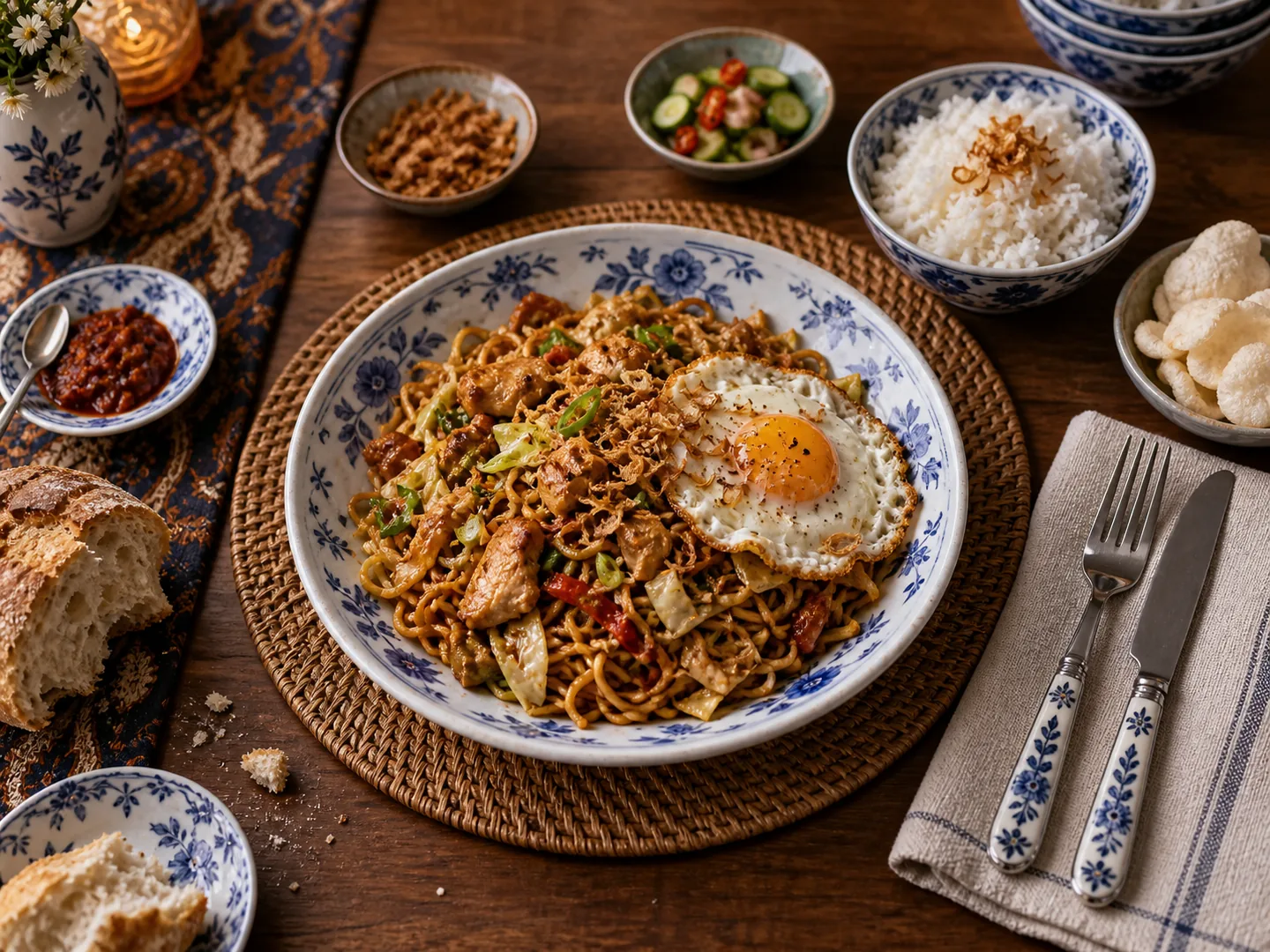
Bami goreng
The fried egg noodles that came home from the Indies, wok-tossed with a spiced bumbu, ketjap manis, chicken and cabbage, and served across the Dutch table beside nasi.